

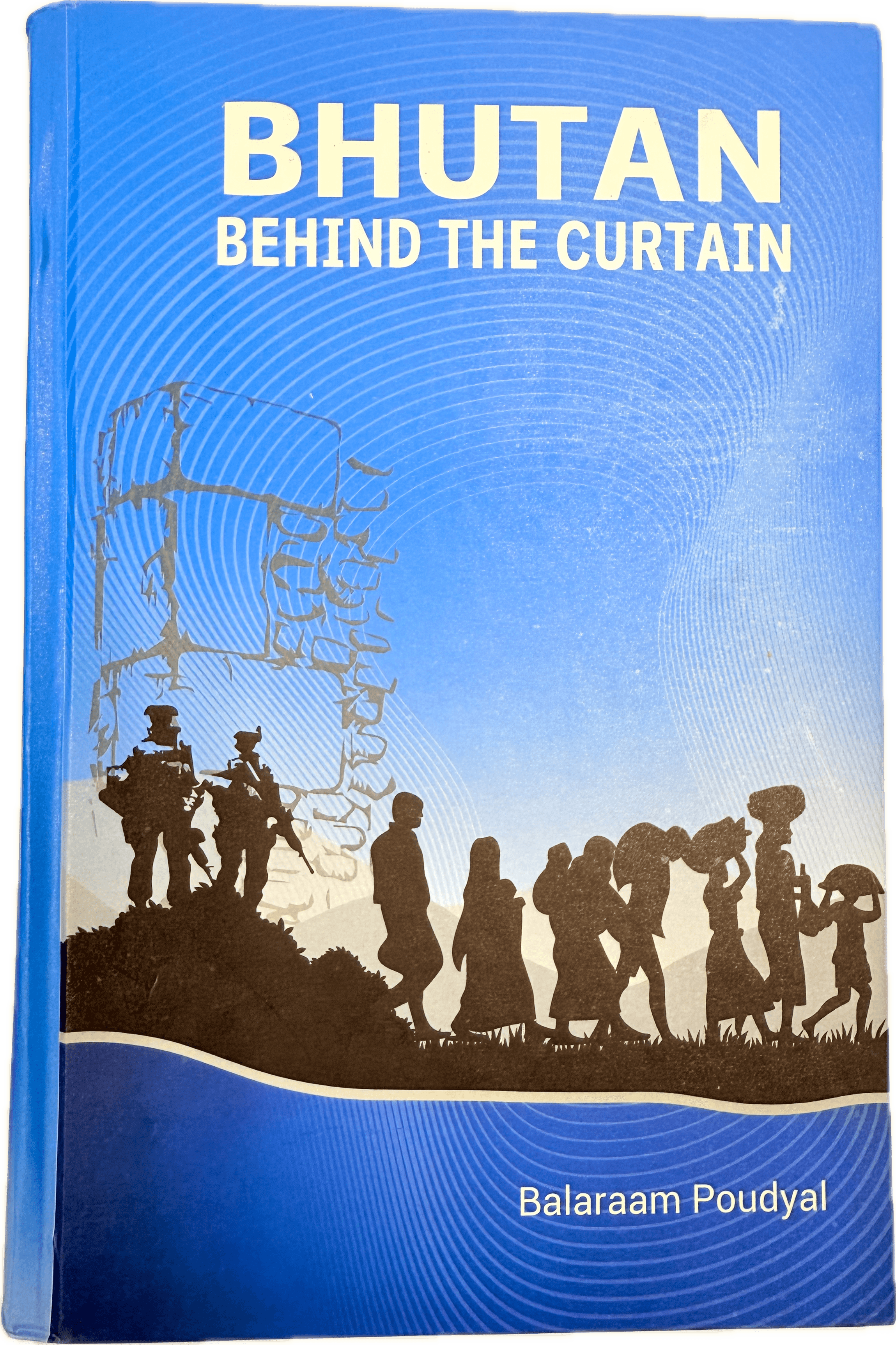
by Balaraam Poudyal
"Bhutan Behind the Curtain' by Balaraam Poudyal, a vivid confluence of history and memoir, brings to the surface the long-concealed secrets of Bhutan's past. With narrative integrity and factual precision, the work documents Bhutan's political and social history as a modern state - tracing the arrival and settlement of the Nepali-speaking community and the role they played in the country's development, security and administration. It also lays bare the chasm between the romanticized myths often heard about Bhutan and the lived realities of its persecuted citizens.

Mr. RP Subba was born and raised in Samchi district, Bhutan. He received a bachelor’s degree from Sherubtse College in 1989. That same year, he... Read More
2025-10-19
A review session of Balaraam’s book ‘Bhutan, Behind the Curtain’ was organized in Harrisburg, Pennsylvania on August 15, 2025. I attended the event in person but did not get the opportunity to share my thoughts. This written review, therefore, is an attempt to make up for that missed opportunity, and to place on record my thoughts on the author’s work. Every reader will arrive at their own conclusions and criticisms after reading the book—and I am certain many already have. These are my observations, and they are not perfect. I suggest that the author openly acknowledge feedback and consider incorporating them in the book’s second edition. With this, I also would like to extend my heartfelt congratulations to the author for his resilience and dedication in bringing this book to fruition.
The original book was written in Nepali language. However, this review is based on its English translation. That naturally presents some inherent challenges, as linguistic transpositions—no matter how meticulous—may inadvertently create some natural gaps, limiting the reviewer’s ability to fully grasp the full depth of the author’s original expression, sensitivities, intent, and nuanced contextual underpinnings. Nevertheless, my work was made much easier through the scholarly diligence of Mr. Bhishma Prasad Sangroula, who translated the book seamlessly from Nepali into English, and Mr. Narayan Phuyal Sharma, who meticulously edited it. Both went well beyond usual expectations, painstakingly preserving the essence of the original text, while maintaining its subtleties. I appreciate and acknowledge that their efforts have greatly elevated the book’s overall quality and presentation.
My engagement with ‘Bhutan, Behind the Curtain’ unfolds through three critical lenses—what I did not like, what I found unnecessary, and what I liked in the book. I also approached this book both as a reader and as a critic, examining its data and situating how these ideas connect with the larger discourse surrounding identity politics, exile, and diasporization.
What I did not like:
I found the use of the term ‘homeland’ particularly detesting. Throughout the book, this term has been repeated twenty-three times. This lexical choice carries significant political implications to the ideological essence and orientation of the Bhutanese democratic movement of 1990. The stated objective of this movement was the cessation of state oppression and persecution—and the establishment of human rights, inclusion, identity, justice, protection, democracy, and rule of law etc. To cast this movement in the vocabulary of ‘homeland’ politics—risks a serious mischaracterization—one that conflates its orientation with that of subnational groups fighting for territorial self-determination. The Bhutanese political parties spearheading the 1990 movement harbored no such ambitions. In fact, this movement was neither derivative nor imitative of any contemporaneous ethno—territorial ‘homeland’ agitations that had swept nearby regions in the recent past. Therefore, framing this struggle as a ‘homeland movement’ is to diminish its moral gravitas into a discourse that is fundamentally antithetical to its very democratic essence.
Ideological framework and sociopolitical context of ‘homeland’ movements emerge from the complex interplay of language, identity, suppression, discrimination, exclusion and persecution. Such movements are typically organized by ethnic, linguistic, or cultural identities seeking a political redefinition of belonging. In this sense, ‘homeland’ movements are simultaneously political, territorial, and cultural in nature. Such movements are often wrapped in the language of ‘self-determination’. Notable examples in the South Asian region include the Bodoland movement in Assam, the Gorkhaland movement in Darjeeling, the Tamil Eelam movement in Sri Lanka, the Baloch movement in Pakistan, and the Chittagong Hill Tracts movement in Bangladesh—all of which pursue varying degrees of autonomy, statehood, or independence, either within—or at times beyond the constitutional framework of their respective states.
The Bhutanese movement of 1990 was not driven by a quest for ethno-territorial motives, but by demands for equality, human rights, justice, democratic reforms, rule of law etc. Its ideological orientation was fundamentally civic and national, rather than subnational or ethnic. From a political standpoint, the presence of the Nepali-speaking population in Bhutan—being relatively recent in historical terms—renders any notion of a ‘homeland’ claim incongruous and unpragmatic. Even the ruling Ngalong-Drukpas of northern Bhutan cannot plausibly advance such a claim. Therefore, categorizing the Bhutanese protests of 1990 as a ‘homeland’ movement makes it politically reductive and it obscures its democratic essence.
Another point that I did not like is the author’s repeated references to India’s role. On page 313, he notes that the exiled Bhutanese leadership ‘appealed to the Indian government to facilitate resolution through the mediation of both the Bhutanese government and the aggrieved parties’. On page 323, the author quotes Mohan Tamang, President of the Democratic Youths of Bhutan (DYB) saying ‘Both our parent party Bhutan National Democratic Party (BNDP) and the Druk National Congress (DNC) were clear about the necessity of India’s involvement in addressing Bhutan’s political crisis’. On page 368, the author records—‘In August 2000, Nepal’s Prime Minister Girija Prasad Koirala, during his visit to India, sought assistance from the Indian Prime Minister Mr. Atal Bihari Vajpayee, in resolving the Bhutanese refugee problem’.
In summation, these statements seem to suggest that India’s involvement as an arbiter in resolving the Bhutanese crisis was indispensable. This perspective continues to echo even today among many Nepalese officials in Singa Darbar, and some individuals in the Bhutanese diaspora. However, such an interpretation overlooks the fundamental asymmetry inherent in a triangular diplomacy among Nepal, India and Bhutan. When it comes to arbitrating between Nepal and Bhutan, India’s neutrality is often questioned. In fact, India’s geopolitical alliances and geostrategic preferences in the Himalayan region have consistently favored the regime in Thimphu. Given its geographic proximity and regional dominance, it is not difficult to imagine that Indian strategic interests and geopolitical expediency would overwhelm any triangular diplomacy among the three countries. As India would occupy the center stage in these dynamics, its efforts would likely be directed towards steering the negotiations along a course deemed expedient to Bhutan’s strategic interests. India could even propose to absorb all the Bhutanese refugees within its own borders, without feeling any demographic strain, thereby subsuming Nepal’s options. Having long sought India’s involvement in the process, Nepal’s options for contesting such an outcome would be pre-emptied, and the Bhutanese refugee issue would effectively end. In this context, India’s direct involvement in the Bhutanese refugee negotiations would have been politically disastrous, if not totally suicidal—to both Nepal and the Bhutanese refugees.
Fortunately, by the quiet play of circumstance, such a scenario was averted, leading instead to the eventual resettlement of Bhutanese refugees in various western countries—a solution that opened new possibilities for rebuilding their lives with new hope and dignity. Had they been absorbed into India under a different political calculus—their fate, even today, would have remained notoriously uncertain and precarious.
Next, I was disappointed by the deliberate omission of my own contribution to the movement, particularly the political protest on June 2, 1999—where I as the General Secretary of Bhutan Gorkha National Front (BGNLF) led 101 participants representing six Bhutanese refugee camps in Nepal—on a political mission to Bhutan. Early that morning, we traveled from Nepal in hired buses, proceeding through Panitanki and onward to Phuntsholing, where we successfully crossed the border into Bhutan. We assembled near the Ganesh statue—the center of Phuntsholing town and began our march with party flags and banners. Our objective was to proceed to the capital city—Thimphu. Barely fifteen minutes into the march, we were intercepted by the Bhutanese police, who suddenly appeared from behind, forming a human barricade to block our path. Our flags and banners were seized, and we were ordered to turn back.
The operation was led by the town’s Officer-in-Charge—Sherub Tenzin. Given Bhutan's historical apprehension towards political assembly and public dissent, our protest provoked immediate State reaction. I pleaded with Sherub to let the march continue, insisting that we were peaceful and that our sole intention was to proceed to Thimphu to present our grievances to the King. However, my plea was dismissed, and we were forced to retreat to the bus station under police escort.
As we walked back, we halted briefly in the parking lot on the north side of the bus station. There—a group of men—likely Royal Bhutan Army cadets in disguise, attempted to overwhelm and intimidate us. Sounding overly aggressive, some of them hurled verbal threats as if they were purposely deployed to provoke a confrontation. The strategy was clear—should any violence erupt; the government would frame it as an altercation among civilians—a tactic that would enable it to maintain both internal control and external deniability. The episode, though brief, revealed the lengths to which the state was prepared to go to suppress even the faintest expression of public dissent in Bhutan.
Following our arrest that day, we were escorted to the iron-gated bus station—an area used for ticketing and transiting to various destinations from Phuntsholing. The bus station, which remains busy throughout the day, was abruptly closed and repurposed as a temporary holding site, where we were confined within its barred enclosure. Interrogations followed for nearly three hours before we were transferred to another facility atop the hill, adjacent to the Norgay Cinema Hall—the old Food Corporation of Bhutan (FCB) building. Several high-level government officials—civil administrators, police officers, and army personnel visited throughout the day—their attention mainly focused on me. By 7 pm, though unexpected, we were served bread and tea. Yet, by midnight, we were suddenly ordered to vacate the premises and board two Indian buses waiting in the parking lot. Then, under heavy escort, we were driven to Jaigaon, the bordering town on the Indian side.
From Jaigaon, our convoy moved towards Panitanki, flanked by two Indian military vehicles—one at the front and one at the rear. Upon reaching Panitanki, the border with Nepal, the Indian security personnel, with their guns pointed at us, ordered us to swiftly cross the border and proceed into Nepal.
Since then, the Bhutan Gorkha National Liberation Front (BGNLF) organized four successive protest marches in Phuntsholing. These were the first protest demonstrations held inside Bhutan by any political party. The only comparable attempt prior to this was undertaken by human rights activists in the name of Appeal Movement Coordination Council (AMCC), in which 50 participants successfully staged a protest demonstration in Puntsholing on August 15, 1996, under the leadership of Mr. Jogen Gazmere. Regrettably, neither my efforts nor the subsequent protest demonstrations carried out by the BGNLF receive any mention in Poudyal’s book. Such an omission is highly concerning as it compromises the narrative of our historicity.
I also take issue with the fact that the book includes numerous inaccuracies misrepresenting key data and names involved in persecution history. Some of them are minor errors, others constitute more serious mistakes, yet others seem to be the outcome of extreme carelessness. If left uncorrected—these mistakes would deeply undermine both the credibility of his work and the purpose behind its publication.
Below, I shall point out these mistakes and provide contextual clarifications where necessary.
The author appears to have uncritically adopted the term ‘Sarpang’ (page 34)—the name of a place officially changed by Bhutan in the early 1990s. The original and authentic name of the place, as it has been known to local communities for generations, was ‘Sarbhang’. This name was replaced by ‘Sarpang’ as part of the state’s broader policy of reconfiguration—historical, linguistic, and cultural. Likewise, the state has systematically replaced the original names of all districts, sub-divisions, blocks, and villages in southern Bhutan with new Dzongkha names. The author’s apparent lack of sensitivity to such critical nuances, and his uncritical replication of the state’s terminology reveals serious oversight. As such, the restoration of original names such as ‘Sarbhang’ represents not merely an act of toponymic reclamation, but a profound assertion of resilience.
Next, the author has stated that the Doya, and Tota tribes of Bhutan are of Tibetan origin (page 35). This is a naked blunder. Both the Doya and Tota are indigenous people whose presence in Bhutan predates any Tibetan immigration to Bhutan—the earliest of which appears to have occurred between the 7th—9th centuries. From Songtsen Gampo (c. 627–649 CE; reign—approximately 618–649 CE) to Shabdrung Ngawang Namgyal (1594—1651 CE; reign—1616–1651 CE) successive waves of Tibetan migration to Bhutan continued in various phases from the 7th century CE up to the 17th century. These two Tibetan figures share striking political parallels in history—one unified Tibet, while other unified Bhutan. To conflate the Doyas and Totas with Tibetan immigration to Bhutan only misrepresents their unique ethno-historical identity in Bhutan.
Next, the author states that ‘the third national census was conducted for the first time to confer citizenship to the people of the country’ (page 41). This is wrong. Citizenship was formally conferred to the Nepali-Speaking southern Bhutanese through the Nationality Law of Bhutan, 1958. Census exercises are conducted for record keeping, not for granting citizenship.
Next, the author states that ‘conducting an annual census has been a long-standing tradition in Bhutan’ (page 187). This is not true. Bhutan conducts its national census approximately every 10 years—not annually. The first national census was conducted in 1969, and subsequent censuses occurred in the years—1980, 1988, 2005, and 2017.
Next, the author erroneously referred to Father Gerald E. Leclaire, the Principal of Sherubtse College as a ‘British citizen.’ (page 193). Again, this is carelessness. Any literate Bhutanese will know that Fr. Leclaire was a Canadian citizen.
Next, the author mentioned that Zangley Dukpa was a ‘Dzongkha language teacher’ (page 193). This is another factual error. Zangley Dukpa was not a Dzongkha language teacher. He was among the first batch of graduates from the Teacher’s Training Institute (TTI) in Samchi, where he was trained as a primary school teacher.
Next, the author claims–‘Until the year 1990, the Nepali language remained as a compulsory subject for students belonging to the Nepali community’ (page 203). This claim should be treated with caution, since the exact year when Nepali language was discontinued from the school curriculum remains disputed. However, it is certain that by 1989—the Nepali literary societies (NLS) that existed at Sherubtse College and the NIE had been abolished. Based on my own experience, Nepali language ceased to be a compulsory subject by 1978—the year I sat for my class five common examinations from Ghumauney Junior High School—though it continued to be offered as a non—mandatory, optional subject for some years into the early 1980s.
Next, the author refers to the Dzongda of Samchi as ‘Lhakpa Tshering’ (pages 210–211), which is incorrect. The correct name is Lhakpa Dorji—a fact he correctly states later in page 233.
Next, the author claims that the Garganda camp merged into the Siliguri group on June 26, 1990. Once again, his account takes an expedient turn—failing to accurately portray the group dynamics at play during that time. In reality, the opposite was true. By that time, Garganda—conveniently located near Bhutan’s borders was already a secure hub populated by more than twenty-five camp residents, mostly students—with some additional accommodation available for new arrivals. In contrast, the Siliguri group consisting of five disarrayed and isolated individuals had no place to settle as a group. It was during this crucial phase that RK Budhathoki made frequent visits to Garganda, engaging closely with the residents there—perhaps anticipating an organizational alignment in his favor. Consequently, the understanding that followed paved the way for the merger and integration of Budhathoki and his group into the Garganda camp community.
Soon after Budathoki and his team relocated to Garganda, the BPP, SUB and PFHR formulated a plan to organize a mass protest demonstration in Phuntsholing under BPP’s banner—where thousands of participants from all six districts of southern Bhutan would converge at a single site. The event was scheduled for August 26, 1990—but it never materialized since it was thwarted by Indian intervention.
Unhappy with the situation, the BPP, SUB and PFHR, then formulated a new strategy to launch hunger strike programs at three locations—Kathmandu, New Delhi, and Ramjhora, West Bengal. These actions were designed as preparatory measures for raising international awareness and generating momentum for the upcoming initiatives planned for the following month of September—for launching a series of major protest demonstrations in all six districts within southern Bhutan.
The event in Kathmandu—led by Hari Adhikari (MLA), was staged outside the SAARC Secretariat, while the one in Ramjhora, near Garganda, was organized under the leadership of R.K. Budathoki and other leaders at Garganda. The latter attracted over 2,000 participants from inside Bhutan, and garnered the support of hundreds of local political leaders who attended in solidarity. At that time, the Garganda camp was already overflowing with over 2,000 residents, and new arrivals continued to pour in each day. To prevent further influx, the party was urging those still inside Bhutan to remain where they were and advised others who had already left the country to return—assuring them that we would soon be taking the movement back into Bhutan through a new wave of mass demonstrations.
The third and most significant program was the hunger strike staged at the Boat Club, New Delhi, on September 12, 1990. This event was organized under the leadership of BPP General Secretaries Mr. D.K. Rai, and Prof. Hari Prasad Adhikari, Mr. K.B. Panglung of PFHR, and Mr. I.B. Pathak of SUB. In addition to the participants who had come from Garganda—eleven Bhutanese students from Varanasi Sanskrit University also joined the hunger strike. At one point, the organizing team exhausted all their resources, prompting Mr. D.K. Rai to instruct Mr. I.B. Pathak to return to Garganda to collect additional funds. Upon his arrival, Mr. Durga Giri—another senior BPP leader—provided him with INR 10,000, enabling him to return to Delhi and continue sustaining organizational works. However, the author appears to have overlooked this event—one in which his own party played a central and defining role.
Fortunately, the author did not omit another significant event; a twelve hour sit—in protest held at the same grounds—the Boat Club, New Delhi on August 21, 1992. This program had a greater impact and was far more consequential. Poudyal notes that it was organized by BPP and YOB. However, he fails to acknowledge that I was the primary organizer of the event. The program was organized under the leadership of Mr. Rakesh Chhetri, who was then serving as Vice President of the Bhutan Peoples’ Party.
Next, Poudyal writes that ‘a shelter was established within the Garganda Tea Garden premises on December 19, 1989, under the leadership of Dilip Thapa’ (page 282). This must be interpreted according to context. Dilip Thapa was an Indian citizen and a resident of Garganda, not a Bhutanese national. His role was purely humanitarian. Although he exercised considerable influence on us—by no means—it should be concluded that he had assumed political leadership of our movement. Therefore, suggesting that the Garganda camp was established under Thapa’s leadership is misleading.
Next, the author asserts that ‘a significant number of expelled Bhutanese individuals who had not received asylum in India were denied entry into Nepal due to lack of passport documentation’. (page 268). Again, this assertion must be interpreted in its proper context. Although, official regulations required passports—entering Nepal during those days was not particularly difficult. In practice, we freely crossed the border as often as we wanted without possessing a valid passport issued by the Government of Bhutan. Likewise, the Bhutanese refugees entered Nepal and populated the camps in thousands—none of them holding Bhutanese passports. The process by which the Bhutanese refugees were permitted to enter Nepal was guided entirely by compassion and humanitarian concern—rather than by bureaucratic procedure or formality. However, refugees were required to produce other forms of evidence that could establish their identity as Bhutanese citizens.
Next, the author refers to the Ralung Monastery in Tibet as ‘Ralung Dynasty’. This is a reckless error. Ralung is not a dynasty but the principal seat of the Drukpa Kagyu lineage. A ‘Ralung dynasty’ has never existed.
What I did not Understand:
One can discern a pattern of selective omission which is particularly striking as it overlooks the contributions made by others—no less important than those of the author himself. For example, the author highlights the roles and contributions of BPP and YOB, while largely overlooking the efforts of other key figures. Notably, the contributions of Mr. Rakesh Chhetri and Mr. S.K. Pradhan does not find a mention in his book. Both were prominent leaders within the BPP, serving as Vice President and General Secretary, respectively. Both contributed significantly to the party’s political and organizational development. Additionally, he has bypassed an entire episode—a series of protest rallies organized in Phuntsholing under the BGNLF banner in 1999. Even Dr. Bhampa Rai’s contributions during the Maidhar era are not adequately acknowledged. It is difficult to comprehend why the author has chosen to neglect the contributions of other leaders.
Another aspect that I was unable to grasp is the elaborate exposition of the caste system among the Hindu Nepali-speaking population in Bhutan. In the same length, the author also devoted considerable space to detailing hundreds of clan names of the Limbu, Rai and Magar ethnic groups (pages 35–38). While such digressions may hold some ethnographic value—they were largely extraneous to the book’s thematic focus; and were therefore unnecessary.
Things I liked:
One of the book’s notable strengths lies in its extensive repository of primary data, reflecting years of meticulous effort—particularly within the realm of Bhutanese exile literature. These materials are invaluable as they provide a vital foundation for future scholars to engage with, study, analyze and write our own historiography. Data is knowledge—and its compilation and preservation must take priority over analysis and interpretation—tasks that can be more securely undertaken by later generations. Indeed, few individuals, if any, within the Bhutanese diaspora have collected such a vast corpus of primary data. Without the author’s painstaking documentation and compilation of such essential resources, opportunities for future inquiry and research would have been easily lost. And indeed, as we navigate through the formative stage of writing our own history, such books must be given acceptance. It is in this context that the author’s contributions must be recognized and appreciated.
Next, the author refers to the eastern Bhutanese as the ‘Tshangla-speaking’ people (page 27). This seemingly minor choice of terminology is, in fact, politically and culturally significant. Identity, after all, is primarily cultural, rather than geographic. The term ‘Sharchhop’ which literally translates as ‘easterners’ in the Dzongkha language, is merely a geographic orientation rather than an ethnonym. Therefore, ‘Sharchhop’ and ‘Tshangla—speaking people’ are two different terms with two different meanings. The term ‘Tshangla-speaking’ more accurately reflects the community’s identity. I have long preferred to use the term ‘Tshanglaps’ as a way of respectfully acknowledging their ethnocultural distinctiveness and ethnohistorical identity.
The author also deserves commendation for deliberately discarding the term ‘Lhotshampa’, which literally means ‘southern dweller’. This label—politically crafted by the Bhutanese regime in the 1970s—was used to distort and erase southern Bhutanese identity. Unfortunately, many exiled Bhutanese writers have perpetuated this distortion by uncritically accepting and adopting the regime’s terminology. This calls for a collective effort for joining what The Bhutan Research and Information Network (The BRAIN) has long been advocating—the establishment of a ‘common language’—a broad understanding and agreement on the choice of words and terminologies—and their application to halt further distortion of our history. By consciously rejecting the term ‘Lhotshampa’, Poudyal has set a significant example to future writers, in establishing this ‘common language’. This effort is duly recognized and deeply appreciated.
The author also depicts the exile climate and dynamics as one proliferated by coalition groups, which emerged periodically under different names—yet largely remaining purposeless and eventually fading away without a trace—which is a fair criticism.
‘Bhutan, Behind the Curtain’ though lacking analytical depth and critical engagement, is richly endowed with comprehensive and foundational data which can help in understanding the dynamics of Bhutan’s democratic movement of 1990—situated at the intersection of politics, human rights, democracy, governance, rule of law, identity, displacement, Gross National Happiness, and resettlement. Had this book been written for school—of course with necessary revision and corrections—it could serve as a Grade 12 textbook—providing a valuable starting point for emerging researchers seeking to contextualize the Bhutanese movement and acquaint themselves with its historical, political, and social dimensions.
In conclusion, I find the title of the book, ‘Bhutan, Behind the Curtain’, particularly appropriate and enticing. It exposes the duality of Bhutan’s image—one carefully crafted for external consumption, and another ruthlessly hidden to safeguard its own internal facade. The first image—visible outside the curtain embodies a meticulously maintained façade, marketed by pretense, posturing, and state propagation. Such an image is sustained through instruments of soft power, notably the much—celebrated Gross National Happiness philosophy, green cover and the country’s carbon-neutral environmental policy etc. The second image—Bhutan Behind the Curtain—unveils what lay hidden behind the curtain—Bhutan’s troubling record of human rights violations, cultural, economic, and political exploitation, and the persecution of minorities. Those who view Bhutan—from outside the curtain—see Bhutan as a happy state. They advocate for ‘forgiving’ and ‘forgetting’ Bhutan’s past excesses in the name of national reconciliation. In contrast, those who look at Bhutan Behind the Curtain—they see skeletons in its closet. They may perhaps ‘forget’ in the interest of a national reconciliation—but they will never truly ‘forgive’ the physical and psychological scars afflicted on them by the Bhutanese state.
Charlottesville, VA.